
I always go to my head - why is it so hard to be in my body?
Here’s how to go from intellectualized to authentic embodiment.
“This course is completely different to all other work I’ve done over 40 years, which did not ultimately address the fundamental body issues.”
It’s anatomy, physiology, and how your body processes gravity
If you Intellectualize, micromanage, or try too hard, you are not speaking your body’s language.
Being in the center of yourself is a vibe that other people can actually see.
Maybe you still do these things, despite all your intentions:
+ Micromanage from your thoughts
+ Feel performative when doing somatics
+ Feel like you’re trying too hard
+ Routinely disconnect from your body
Being self-possessed, being with yourself in an effortless way, emerges from self-trust. This happens when your body can reliably support you under real conditions—stress, complexity, pressure, emotion.
The solution is entirely physical at the core…but it’s also the foundation for emotional resilience.
If your posture unconsciously collapses, braces, overworks, or disconnects when life intensifies, no amount of mindset work will hold.
This program shows you how to rebuild internal support through somatic posture, so trust is no longer something you have to believe in, you truly feel it.
“This was very profound and emotional. I feel this odd feeling, a central anchor. I was just moving with ease and felt …ALIVE. I have spent so much of my time “gripping”, trying to pull myself up and always feeling somewhat exhausted.”

You know what it feels like to be frustrated in yourself… that you know better.
Here’s what happens when you cultivate a stable, intimate relationship to your own power
You can watch yourself make different choices in real time.
You feel less activated when faced with old triggers.
You become more generous - with yourself, and with others.
This is an approach that gives you the skills to consistently, reliably come home to your locus of control: the center of your body.
And you won’t have to correct, micromanage, or otherwise BE IN CHARGE of it all.
Instead, you are in a healthy, trusting relationship with your body, one that is not bound by protecting against failure or imperfection in how you move through life.
Living in flow requires you have a trusty anchor that is available all the time, predictably and immediately.
Why Self-Trust Breaks Down
When support in the body is compromised, the nervous system compensates.
You may experience:
A constant sense of effort, even when things are “going well”
Over-thinking simple decisions
Feeling ahead of yourself, or slightly disconnected
Difficulty resting, even when you stop
Subtle anxiety without a clear cause
These aren’t personality traits.
They are physiological signals that you interpret as lack of safety.
When your posture relies on bracing, gripping, or collapsing, the nervous system stays alert.
Trust cannot grow there.
“It brought me to tears, feeling like that part of me is beginning to come home and take up space. Over 25+ years, I’ve done all the things trying to “fix” myself, increasing tendencies toward rumination, hypervigilance, and self-doubt.”
THIS is what you’ve been missing:
Most mind-body tools can make you feel better in the moment.
But they don’t change who you are when you’re upright:
in your workday, your relationships, your responsibilities, your real life.Somatic posture builds a path to be self-possessed in your daily life.
If you feel like your current practices are rinse and repeat, you are in the right place - this roadmap is clear and makes sense.
This is why Coherent Body works: your deep brain knows how to self-organize
Your subcortical brain processes over a million times faster than your conscious brain.
When you learn how to generate those deep brain signals for balance and internal connectivity, you operate in your daily life with a depth of stability that translates into calm and presence.
By using a multi-sensory process, you can signal stability all at once, through minimal adjustments to auditory, visual, and postural cues.
NOTE: If you have a strong anterior tilt, you might be better served by following a different course first. CLICK HERE to learn more.
“Within a few minutes of practice I felt my body craving the practice. It’s like I’d been gifted a key.”
What You’ll Learn To Do Instead of Bracing
Somatic posture is not about standing straighter or holding better alignment.
It’s about where support originates.
In this work, you’ll learn how to:
Restore support from the lower body upward
*NOTE: If you have a strong anterior tilt in your pelvis, you’ll work from your shoulders down. CLICK HERE to learn more.Reduce reliance on surface tension and muscular holding
Reconnect pelvis, diaphragm, spine, and head as one system
Shift from effort-based stability to internal organization
When support reorganizes, something important happens:
Your body stops asking, “Am I safe?”
And starts responding, “I’ve got this.”
That is self-trust and it’s the foundation to recover a fractured personal narrative.
“This course blew me away. So many pieces I’ve learned over the years but nothing like these basic building blocks that can be used daily, hourly, moment by moment.”
This is how you get out of your head and to the center of your body: new body skills that you can internalize.
A well-designed approach that speaks to both your body and your understanding of it opens the doors to profound changes in body and mind. But it needs to be accessible and reliable in order to integrate them. That’s why I created this course:
Building Self-Trust Through Somatic Posture
In 5 days (or less!), you can plug into the stability, calm, and effortless power that is your birthright as a human standing on earth.
WHAT YOU’LL GET

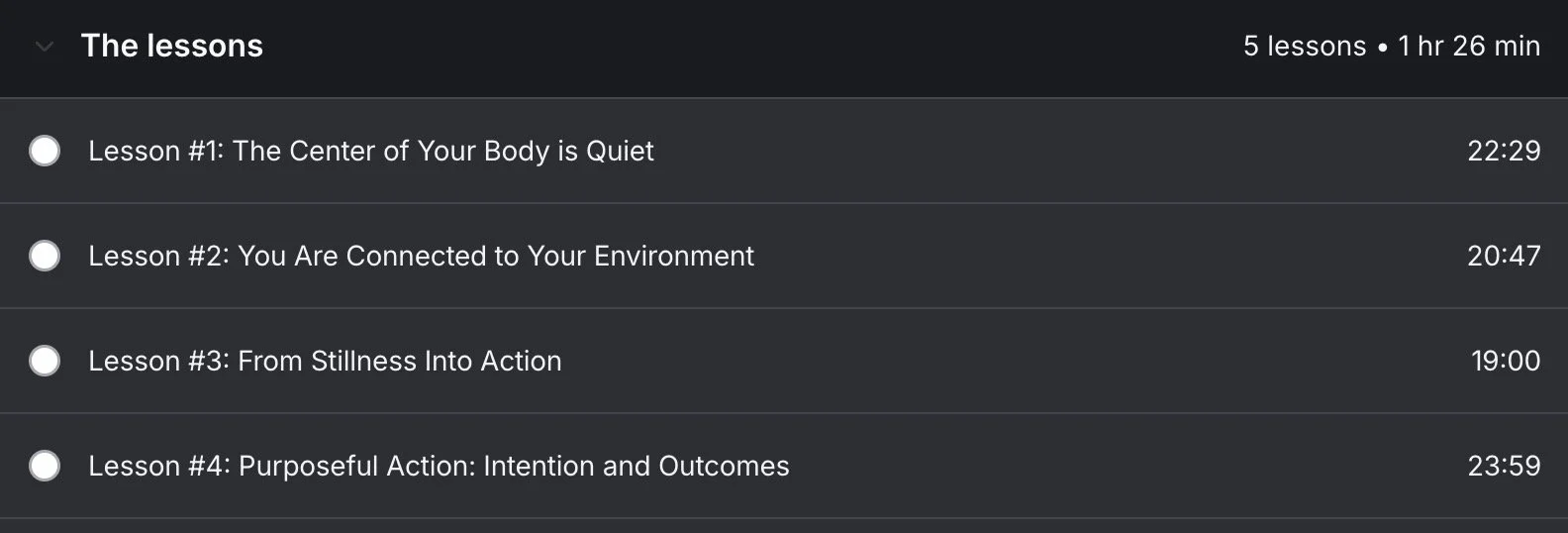
4 Bite-Sized Video Lessons (20-25 minutes each).
Personalized Feedback from Sue Choi, a 25-year expert.
A structured process for accountability.
Bonus material:
+ access to my online community
+ a digital copy of my book When Things Stick: Untangling Your Body From Old Patterns
+ bonus videos that are not included in the book
~~~ are you Ready to experiences changes like these? ~~~


Is this right for me?
Q. I have a strong anterior tilt in my pelvis. Is this course right for me?
A. If the sample exercise at the top of this page worked for you, yes. But if it did not or you are acutely limited by your anterior tilt, I have a better option. Building Self-Trust is included as a bonus if you purchase this course.
CLICK HERE to learn more.
Q. I’ve bought so many courses, but I never sit down and follow through.
A. That’s why I’ve designed this course to encourage participation.
+ There are 4 short videos that you have to implement while you watch it. This can be completed in 1 day, but you have 5 full days to go through to earn the extra bonus.
+ If you go through the course and follow the instructions to earning the extra bonus, you’ll find that it’s surprisingly motivating. You are taking the time to reflect and share both insights and struggles. This act is exactly what is missing when you do courses online by yourself.
Q. Is this course appropriate for someone with advanced somatic practice?
A. Yes, the clarity in instruction is something that even trained somatic therapists and somatic movement professionals find illuminating.
Q. Is there a risk of feeling triggered or overwhelmed by the practices?
A. Potentially, if you are new to somatics. This course is NOT an intro to somatics - it is for people who have experience paying attention to subtle body signals. If you are seeking somatics for trauma for the first time, you should learn that with live support.

WHO AM I?
My name is Sue Choi and I’m a somatic movement therapist and bodyworker with over 2 decades of experience. I’m also author of the book When Things Stick: Untangling Your Body From Old Patterns. Over 20,000 copies have been purchased. Through my private practice, my online program, and my reader audience, what you’re about to learn has been battle-tested.
~ Somatic Posture ~
Your somatic posture involves a powerful and multi-sensory skillset that aligns with what your human system has refined over millions of years: the act of standing on two small platforms called feet.
How exactly can posture change your most embedded mental-emotional patterns?
Your body in standing is a system that seeks the most energy-efficient way to do two things at once:
1. Keep you emotionally safe
2. Prevent you from falling over
Our learned experience of safety (item #1) is intertwined with the skill we take for granted -standing and moving (item #2).
When you learn the key insights to build internal safety, power, and ease in standing (improve how you do #2), this ensures you don’t revert back to your old mental-emotional patterns (formed in #1).
If you give the brain the option to stand in a more energy-efficient way, here’s what happens:
You feel less white noise in your system, which means you feel relief from chronic underlying work in your body just to stand.
Your body helps you: once you get the ball rolling, your body recognizes and accelerates the process of more efficient posture in order to conserve energy.
You build trust in your body because you know how to work with what the body needs instead of trying to fight it into submission.
“As a therapist, this has already changed my practices and perceptions with my clients.”