
What’s the Secret to Unbrace Your Body?
In this article, you’ll learn that unbracing the body is about accessing your body’s purpose, which is the same for bodies of all types, regardless of your personal history. If you have worked through your personal story through therapy or self-development, you’ll discover the body’s purpose is much richer and more meaningful than how you currently experience it. As you unwind the bracing throughout your body, you’ll open the expanse of the present moment.
In the Coherent Body approach, if you are mobile enough to sit and stand from a chair without assistance, and if you can walk outside around the block without getting out of breath, what you’ll learn here will give you a concrete experience of surprisingly potent shifts in your body. Outside of those parameters, you can certainly work with this approach but the outcomes may be clouded by other physical needs.
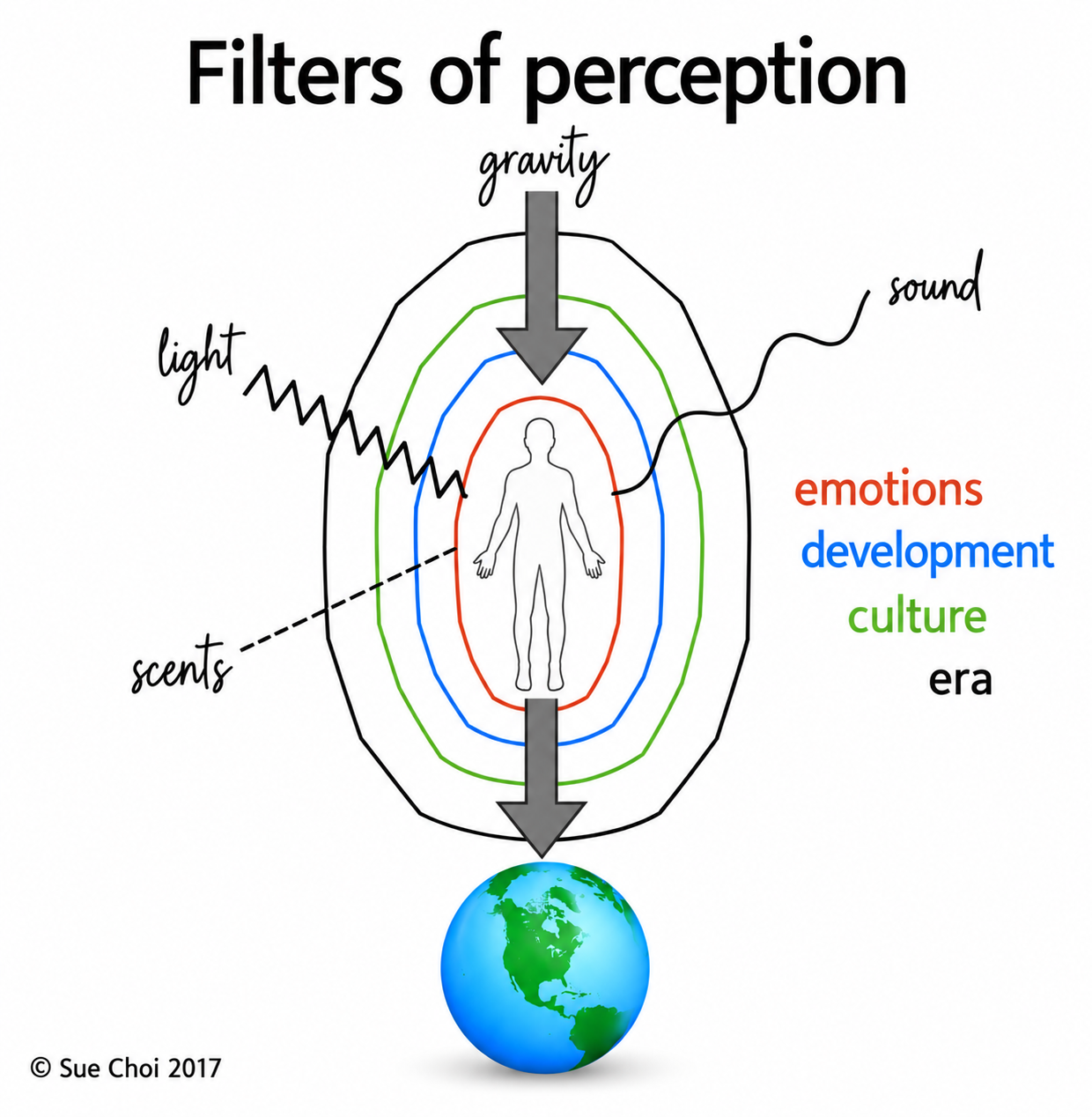
The human system organizes to gravity, light, and sound. This framework is a simplified way to discover the calm and power available to you right now.
What makes you irreducibly human?
That question didn’t start as a theory. It emerged from watching thousands of people struggle to change chronic patterns that clients re-created all day long.
The antidote is dropping down into a level of resource you can access right now and it feels like the experience of a human body standing on Earth. This orientation gives you access to inner support and power, which means less girding against life and less defensive posturing and unconscious protection you might have learned to hold.
Instead of localized stretching, an approach that is aligned with your body is to amplify the intelligence there that has evolved over millions of years to coordinate a human structure to balance on two feet and organize the big bowling ball of a head at the top of the spine. This coordination happens lightning fast, below your conscious thinking. Micro-managing your coordination will feel like bracing because it’s conscious holding that substitutes for deep coordination. This does a poor job and interferes with things like breathing freely and accessing power without strain. Micro-managing might do a survival job, but it expends massive amounts of unnecessary energy.
One alternative is to earn how to use three points of perception in the upright body to triangulate yourself in every moment. These forces are gravity, light, and sound. This is a new way of considering how to be present in your body, and it’s a way that is reproducible and available when you need it most.
The problem in communication
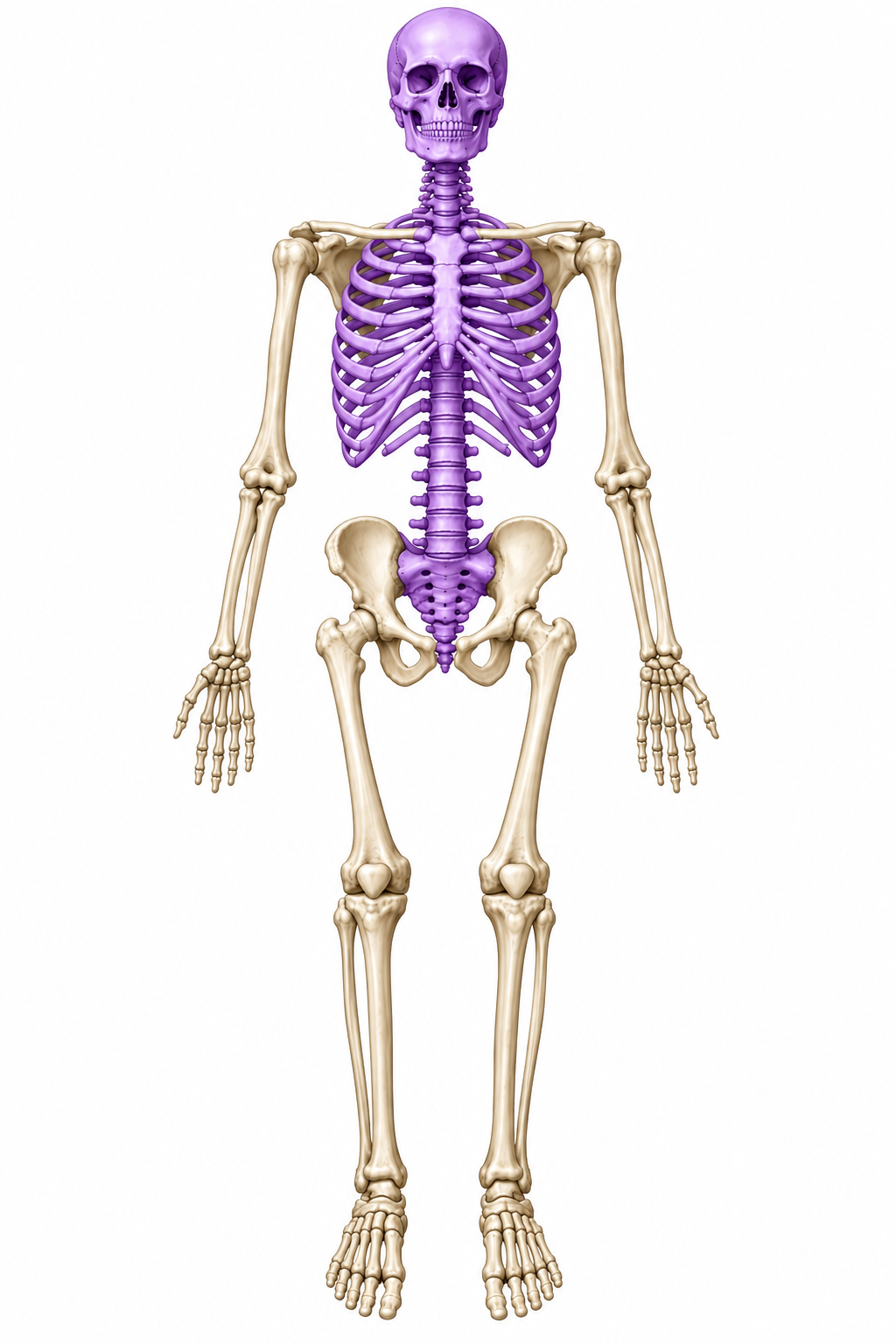
Axial skeleton in purple.
The patterns we hold in standing are unconscious and reveal how much we trust or micro-manage our own body. Balancing the weight centers of the head, shoulder girdle, and pelvis over our feet is automatic, but it’s also dynamic, with opportunity for improvement at every moment. Changing this requires meaningful precision, actions you can deliberately take and that your body understands.
Being instructed to be “more aware” or to “relax into it” or “to do less” are not helpful directives. They are based on the outcome state and describe “what” the endpoint looks like, but rarely lay out a reliable “how to get there”.
The Coherent Body approach gives you two tangible maps to organize around: the axial skeleton and the midline.
The axial skeleton
In standing, being able to feel the whole of the axial skeleton as one unit reminds the body of its capacity to support you. Note that distinction: you are not holding yourself up, you are finding the capacity for the body to support you. When the weight of the axial skeleton is organized over the arches of the feet, you are able to feel how your body is designed to support you, instead of trying to generate the support.
This distinction - feeling support instead working for it - can be a shock to experience. It might also produce some grief, because you recognize that you have been missing this for so long. This is a common experience that passes quickly. You are allowed to grieve what you’ve been missing, but you feel in your bones that more is available. Many people report feeling playful in their bodies again.
Body Experiment #1: Standing on your own two feet
Stand with your feet 2-3 inches apart. Now, do the following move internally and imagine you are doing it so no one can notice it. Position your pelvis as if you are about to take a seat and send your shins forward at the same time. Remember, it’s an internal shift, imperceptible to observers. Take at least 30 seconds to notice what happens. Take longer if you wish.
What changed for you? How did you feel in the whole of your body?
Now position your head to listen to the sounds around you and keep doing what you did above. Imagine you are waiting in line somewhere. Imagine people around you are impatient and stressed about waiting in line.
How do you feel? What changed now?
If you feel more grounded and settled, more spacious and open in the chest, or more relaxed in your shoulders, that’s a good sign. (If not, try it with your eyes closed). It’s such a minor change to stand in this way, yet the change in your whole-body experience can be significant.
Instead of ‘standing up straight,’ you position yourself according to the signals your body is giving you – the change it seeks. The body connects into the ground through the arches of the feet, which you activate by putting more weight into your shins while slightly changing the position of the pelvis.
Can you use these cues when you think of ‘standing up straight’: shins, take a seat, listen? Can you imagine what would happen if you used these cues instead of bracing yourself in anticipation of something you fear / dread / “can’t stand”?
Now organize yourself as if you are listening from the front surface of your spine, deep inside you. Continue to reach your shins forward while you position yourself to “take a seat” within your pelvis. Let the sounds inside the room connect to the front of your spine - listen from the depths of that internal surface. Connect to the sounds outside the room with your ears.
What changed here?
When you organize your body to be touched by sound, both at the spinal level and at the level of awareness in how you position your eardrums to “catch” the sound, you feel what it means to be less defended in order to connect to the environment.
Simple internal adjustments on how to stand on your own two feet can generate a palpable stability without the feeling of bracing yourself against an onslaught of environmental or emotional triggers.
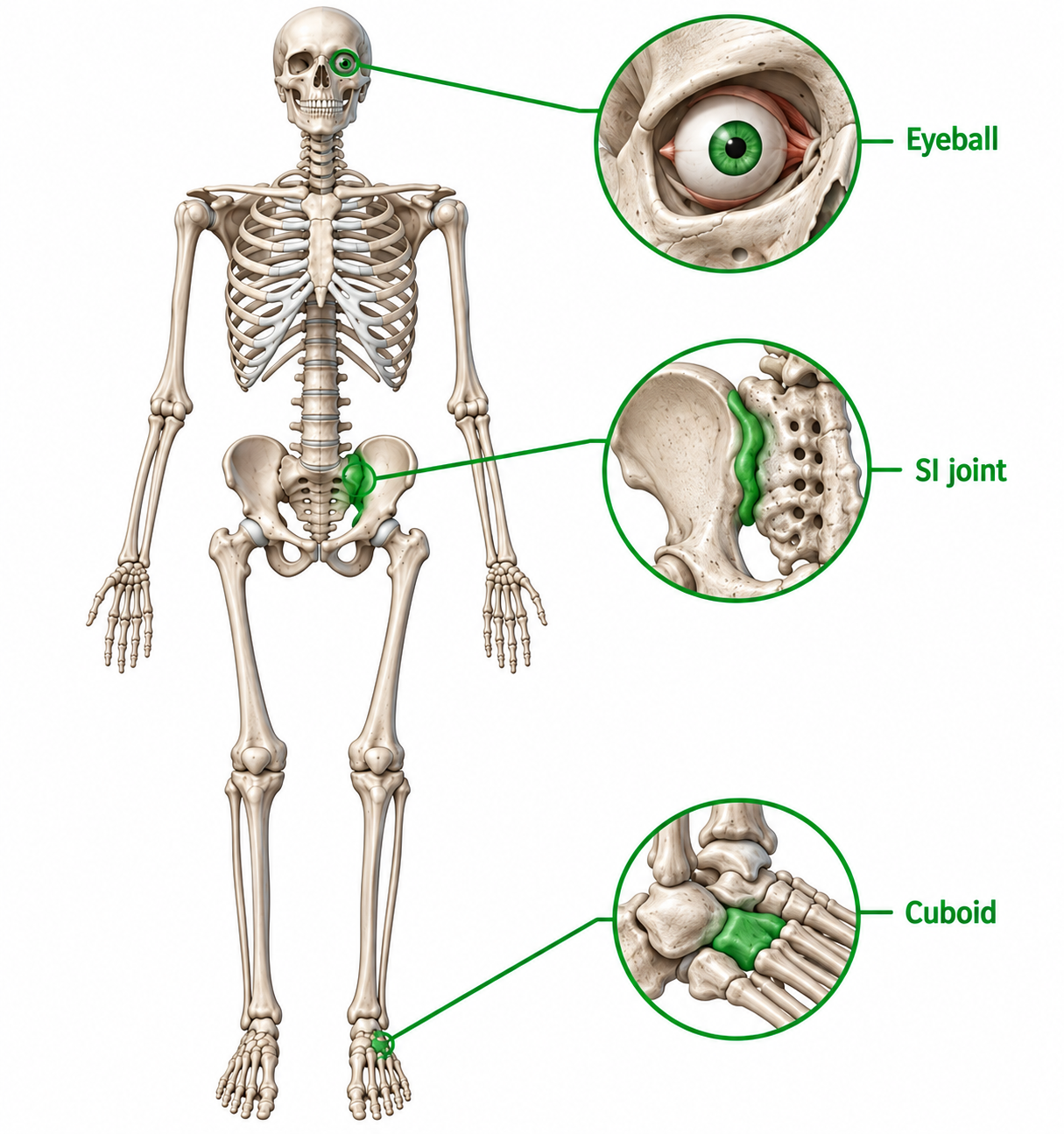
Getting to your midline.
The Midline
The central organizing vertical line of your body is dynamically reinforced as you move and walk. Walking requires a single-legged balance followed by a weight transfer into the other foot. The skill with which you perform this daily action can regenerate and refresh you or it can wear you down.
I’ve identified these three points that orchestrate the balance and weight shift process during the gait cycle: the cuboid in the foot, the sacroliliac joint, and ocular control.
The cuboid stabilizes the foot so the movement spirals up through the leg and hip joint. When the spirals feed into the hip joint, the movement translates through the SI joint and up the spine, as it was designed to do. Using the eye to organize the head keeps the weight of the head functioning like the top vertebra of the spinal column.
Bracing inhibits this flow.
There are multiple points of bracing that happen during this balance and weight transfer, but organization of the whole system through these points encourages the body to work out the kinks. This efficient shortcut can save you years of not knowing where to start or how to keep it all together.
Body experiment #2: Rotating the midline
Come to standing. Turn your forefoot inward so you are slightly pigeon-toed. If you are knock-kneed, put your feet just a little bit wider than how you normally stand.
Now soften in your hips, as if you are about to sit down, as you practiced in Body Experiment #1.
In the following instruction, you're not going to move or slide the feet.
Imagine both forefeet are pushing outwards, as if they are doing the breast-stroke, as if they are parting the Red Sea. Keep all 10 toes anchored. The movement in the forefeet is a push into the floor that drives the spiral up the legs.
Make sure that you don't feel any knee pain! Back off the effort if that’s the case, or turn your forefoot out a little.
When you push against the floor with your forefoot, can you feel your inner heel feels like they are pulling in towards each other?
Can you feel the external rotation happening at the hip joints?
Do you feel your hydraulic center come up through your lower body?
Play with that a few times.
Then walk around a little bit and see how that feels. I call this gecko feet because when people start to feel how their feet support them and connect into their hip joint better, their feet feel sticky like gecko feet.
Do you feel your gecko feet?
Now let's do it with the right forefoot only. And as you do it with the right forefoot, keep your weight in both feet, keeping your weight down the center line.
As you do it with one foot, it's like you're pushing a revolving door.
Now add your right eyeball. Turn it inward, towards the nose. Repeat a few times.
You’re not looking to see, you are just turning the eyeball to correspond to the push of the right forefoot.
Can you feel what it is to move your eyeball, instead of see with your eyeball? It’s a different experience.
Connecting to your ocular control is a body-organization skill that can liberate you from visual bracing. You’re using your eye as an organ of organization instead of an organ of light reception. The eyes perceive space, it perceives light, it perceives movement, but right now you’re using it as a physical handle to organize movement.
Come back to your center. Do this on your left side for a few turns.
Walk around and see how you feel.
This is only your baseline. The process of change requires a new story.
The changes you experienced in these two experiments are signals of possibility. These body experiments are carefully designed to reinforce how the body organizes itself to stand and walk. As you continue to learn body experiments like this, you learn the language of the body: position, weight shift, balance, coordination, internal counter-movements, and inner connectivity. You don’t have to know your anatomy in detail, just the relevant framing that gives you the most direct access to what I call your Body of Resource.
This is your neutral body, the one designed by evolution to perform this coordination in your brain at speeds faster than you can notice, until you are forced to notice, which is why you brace. As you learn to trust and connect to your Body of Resource, it becomes your home base. It frees energy so you have more capacity to be available and make choices.
With this new body experience, you will be required to deliberately reframe your inner narrative. A powerful way to begin this process starts with paying attention to your actions, not your thoughts.
Body experiment #3: Narrating your actions
STEP 1
Do something mundane and narrate it out loud.
For example, as you straighten up your room:
“I’m putting these two pillows in this corner.”
”I’m moving this stack of papers into this corner.”
Use plain and precise language. Practice expanding the granularity of the description. “I’m placing these two green pillows against the corner of this blue couch.”
Do this for a full minute.
What happens? What do you feel in your body, your breathing, your awareness?
Most people experience this as calming, generating more presence and awareness. Here are a few reasons that happens:
First, you are exhaling. When you rush through something you don’t want to do, you often hold your breath because your attention is in the future. Speaking forces exhalation.
Second, you think faster than you speak. By verbalizing, you slow your thoughts.
Third, you crowd out extraneous thoughts that create the internal white noise.
Fourth, you are converging your thoughts and your actions into the moment. Instead of disconnecting from something routine, you are immersed in it.
STEP 2
Now repeat Step 1, but add the word “because”.
“I am chopping this carrot into little pieces because it will cook faster.”
“I’m putting away these books because I want a clean place to work.”
Now what happened for you?
Explaining your actions to yourself out loud in a mundane situation removes the internal resistance to follow-through.
For some, adding “because” creates flow and satisfaction. These are often people who like understanding and meaning.
For others, it adds unnecessary complexity. They find simple narration to be more effective.
Use the version that is more satisfying to you.
Let your body vote on which version is most beneficial for you right now.
Unbraced performance under pressure
Over time, the body experiments change your body, change your thinking, and ultimately changes your behavior. That shows up in meaningfully useful ways under stress, in front of others. Performing on stage is a calculated way to make that stress happen. These veteran stage performers describe what it feels like to access their Body of Resource under stress.